
How to Prepare Your Website for Sale (Checklist)
How to prepare a website for sale: a practical seller's checklist for due diligence, valuation, traffic, revenue, and transfer readiness.
If you want the short answer on how to prepare a website for sale, it is this: clean up your numbers, document your operations, reduce avoidable risk, and make the transfer easy for a buyer. Most deals slow down or fall apart during website due diligence because the seller cannot clearly prove traffic, revenue, expenses, ownership, or operating procedures. Before you list, get your site into a sell-ready state and understand how buyers evaluate monetized properties. If you need the broader playbook first, start with selling and flipping websites.
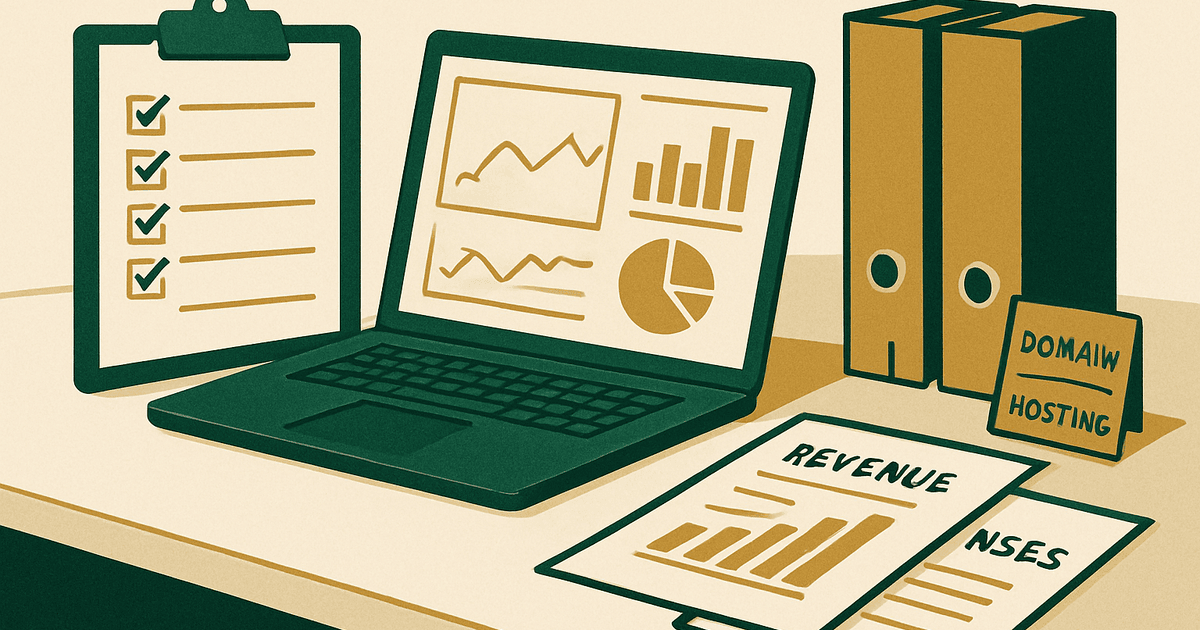
What buyers want from a sell-ready site
Buyers are usually looking for predictable cash flow, stable traffic, low concentration risk, and a straightforward handoff. They want to see that the site can keep operating after you leave. A messy business can still sell, but it usually sells at a discount because the buyer has to price in uncertainty.
For content sites monetized with display ads, buyers will typically look closely at your ad stack, RPM trends, traffic sources, and policy risk. As of 2026, approximately, common ad networks include AdSense, Ezoic, Monumetric, Mediavine, and Raptive. Earnings and RPM ranges vary by niche, geography, and season, so the key is not claiming one perfect number. The key is showing clean, verifiable trends and explaining why the monetization setup is durable.
- Verified traffic from a trusted analytics platform
- Revenue proof from ad networks, affiliates, products, or subscriptions
- A clear expense breakdown and net profit view
- Documented systems for content, technical upkeep, and monetization
- Low dependency on one page, one source of traffic, or one partner
- Transferable assets: domain, CMS, content, email list, social accounts, SOPs, and vendor relationships
The seller's checklist: how to prepare a website for sale
Use this as your working checklist. You do not need perfection, but you do need clean records and honest explanations. A buyer can handle normal business issues. What kills confidence is surprise.
1. Separate business and personal finances
Your site should look like a business, not a side project mixed into your personal bank account. If revenue and expenses run through multiple unrelated accounts, buyers spend extra time reconstructing the economics, and that lowers trust.
- Use a dedicated bank account if possible
- Separate site expenses from household or unrelated business costs
- Create a monthly profit and loss summary
- Tag owner-only or one-time expenses so buyers can normalize earnings
2. Build a clean trailing 12-month financial view
Most buyers want at least a trailing 12-month view of revenue, expenses, and net profit. Some will want 24 months if the site is large enough or if seasonality matters. Break it down monthly so they can see trends instead of just totals.
| Category | What to include | Why it matters |
|---|---|---|
| Revenue | Display ads, affiliate income, sponsored content, digital products, subscriptions | Shows monetization mix and concentration |
| Direct costs | Writers, editors, developers, VA support, tools, hosting, CDN, email software | Helps buyers calculate true operating margin |
| One-time costs | Redesigns, migrations, legal setup, unusual fixes | Lets buyers adjust normalized earnings |
| Owner tasks not outsourced | Hours spent on publishing, ad ops, SEO, partnerships, support | Reveals hidden labor the buyer may need to replace |
If your site uses display ads, export the reporting by month and keep it consistent. Do not combine screenshots from random periods. A simple spreadsheet matching deposits to platform reports is usually enough.
3. Verify traffic and explain how it is generated
Traffic quality matters as much as traffic volume. Buyers will want read-only access or screen-shared verification from your analytics platform and search tools. If a large share of traffic comes from one page or one country, say that directly.
- Document monthly users, sessions, pageviews, and top landing pages
- Break out traffic sources: organic search, direct, referral, social, email, paid
- Show device split and top geographies
- Note major algorithm updates, migrations, or tracking changes that affected trends
- Highlight seasonal patterns so dips are not mistaken for decline
For ad-supported sites, buyers usually care about sessions, pageviews per session, geography, and viewability-related factors because those affect earnings. As of 2026, approximately, network eligibility thresholds commonly discussed in the market include around 10,000 monthly sessions for Ezoic, around 10,000 monthly pageviews for Monumetric, around 50,000 monthly sessions for Mediavine, and around 100,000 monthly pageviews for Raptive, though policies and acceptance standards can change. If your monetization depends on a premium network, be clear about whether the buyer is likely to keep that placement after transfer.
4. Reduce revenue concentration risk
A site that earns 90% of revenue from a single affiliate partner, one viral page, or one traffic source is more fragile than the headline profit suggests. You do not always need to fix this fully before sale, but you should quantify it and reduce the riskiest dependencies where you can.
- Measure what percent of revenue comes from each channel
- Measure what percent of traffic comes from the top 5 pages
- Identify the top countries driving earnings
- Check whether one advertiser, affiliate program, or offer dominates income
- Review whether a single writer or contractor is a hidden dependency
5. Clean up technical issues before due diligence
Buyers do not expect zero issues. They do expect the core site to be stable, secure, and transferable. Technical debt becomes a valuation issue when it threatens traffic, monetization, or the transfer process.
- Update CMS core, plugins, themes, and server software where safe
- Remove broken plugins, unused themes, and abandoned scripts
- Fix major crawl errors, broken templates, or accidental noindex rules
- Confirm backups work and restoration has been tested
- Document hosting setup, DNS, CDN, caching, email routing, and third-party services
- Check that critical licenses are transferable or replaceable
If the site has custom code, explain what it does and where it lives. A buyer does not need full engineering documentation, but they should not discover a mysterious cron job or brittle integration after closing.
6. Organize content and IP ownership
One of the easiest ways to create due diligence friction is unclear content ownership. Make sure you can show that the business owns what it is selling.
- Keep contracts or payment records for freelance writers, editors, and designers
- Verify stock images, fonts, and licensed assets are properly licensed and transferable where required
- List any content generated under special licenses or with restrictions
- Remove or rewrite content that may create legal or policy risk
- Document trademarks, brand assets, and social handles included in the sale
7. Write simple SOPs for recurring tasks
A site becomes more valuable when a buyer can see how it operates without you. This is especially true if your current profit depends on your personal know-how.
- Content production workflow
- Publishing and on-page SEO checklist
- Ad ops or affiliate link update process
- Email newsletter workflow
- Technical maintenance routine
- Reporting cadence and KPI dashboard
These do not need to be fancy. A few concise documents or recorded walkthroughs are usually enough to lower transition risk.
8. Make your monetization stack easy to understand
If your site earns from multiple sources, show how each one works. For display ads, identify the network, account structure, ad layout logic, and any revenue-share arrangements. For affiliates, list the major programs and where links are placed. For products, explain fulfillment, refunds, and support.
Do not oversell RPMs or EPCs. As of 2026, approximately, display ad RPMs can range widely depending on niche, traffic quality, user geography, and seasonality, so buyers care more about your actual historical trend than broad industry averages. The more clearly you connect traffic to monetization, the easier the underwriting process becomes.
9. Prepare a due diligence folder
Think of this as a data room for a small online business. You want one organized place where a serious buyer can verify the basics quickly.
- Profit and loss by month
- Revenue exports and payout records
- Traffic exports and analytics access notes
- Top pages and top traffic sources summary
- Expense ledger and software subscriptions
- SOPs and team/vendor list
- Domain registrar, hosting, CDN, CMS, and email platform details
- Legal documents relevant to ownership or contracts
- A transfer checklist for all included assets
10. Be ready to explain anomalies
No site has perfectly smooth numbers. Maybe you had a migration, lost a major affiliate, got hit by seasonality, or changed ad layouts. That is normal. What matters is whether you can explain the cause, what you changed, and whether the issue is resolved or ongoing.
What to fix before listing and what to leave alone
A common mistake is over-optimizing right before sale. You can spend months rebuilding things that do not materially improve the deal. Focus on changes that improve trust, transferability, and risk profile.
| Usually worth fixing | Usually not worth delaying for |
|---|---|
| Broken tracking, missing revenue records, unclear expenses | A full redesign that resets conversion behavior |
| Major technical errors affecting traffic or uptime | Chasing small cosmetic UX tweaks |
| Unclear ownership of content or brand assets | Publishing a large batch of untested content |
| Messy account access and undocumented systems | Switching monetization platforms without enough history |
| Single points of failure that are easy to reduce | Trying to force a peak season listing if records are weak |
If you can improve cleanly measurable value in a few months, it may be worth waiting. If the work mostly adds complexity or resets the business, it can backfire.
Documents and access you should have ready
Most transfers become easier when the seller has already thought through access and ownership. Before you go to market, write down exactly what the buyer will receive and how each item will move.
- Domain registrar access or push instructions
- Hosting account or migration plan
- CMS admin access
- Analytics and search console transfer plan
- Ad network and affiliate account transfer expectations
- Email service, newsletter list, and automations
- Social profiles and community accounts if included
- Creative files, brand assets, and style guides
- Vendor introductions where continuity matters
For many deals, the transfer process itself is where stress spikes. If you want a more detailed breakdown of handoff mechanics, escrow, and access sequencing, see website escrow and transfer.
How buyers think about valuation during preparation
Even before you list, you should think like a buyer. Valuation is not just a multiple applied to profit. The multiple moves up or down based on risk, growth, simplicity, and transferability.
- Higher confidence in the numbers can support a stronger multiple
- Diversified traffic and revenue usually help
- Simple operations with low owner dependence usually help
- Unclear legal or account ownership usually hurts
- Recent unexplained volatility usually hurts
- A clean growth story with evidence usually helps
If your goal is to improve sale price before listing, the best levers are usually the same levers that improve business quality: clearer reporting, steadier monetization, lower concentration risk, and less owner dependence. For more on that side of the equation, read how to increase website value.
A practical pre-sale timeline
If you are not in a rush, a short prep window is usually enough to make a site far more marketable.
| Time before listing | Priority |
|---|---|
| 90 days | Clean up accounting, verify analytics, reduce obvious concentration risk, fix major technical issues |
| 60 days | Document SOPs, organize contracts and ownership records, simplify tools and vendor setup |
| 30 days | Assemble due diligence folder, confirm transfer steps for every asset, prepare concise seller notes on trends and risks |
| Listing week | Recheck reporting, make sure access permissions are current, and be ready to answer buyer questions promptly |
Final checklist before you go live
- Trailing 12-month financials are complete and easy to follow
- Traffic is verified and source mix is documented
- Major risks and anomalies are disclosed clearly
- Technical setup is stable and transferable
- Content and brand ownership are documented
- SOPs exist for recurring tasks
- All included assets are listed with transfer steps
- You can explain why the business will keep working after you exit
That is what a sell-ready site looks like. If you can prove the numbers, explain the operations, and make the transfer straightforward, you remove a lot of the friction that drags down both deal speed and price. And if your site is monetized primarily with display ads, the broader context in our display ad monetization guide will help you frame revenue quality the way buyers usually think about it.
How long does it take to prepare a website for sale?
What documents do buyers usually ask for during website due diligence?
Should I improve revenue before listing my site for sale?
Do buyers care if my website depends on AdSense, Mediavine, or another ad network?
Get the next guide by email
One practical email when we publish.