
Affiliate Marketing vs Display Ads (2026)
Affiliate marketing vs display ads: which earns more in 2026, when to use each, and the traffic levels where each model makes sense.
If you’re deciding between affiliate marketing vs display ads, the short answer is this: affiliate usually has the higher upside per visitor, while display ads are easier to turn on and monetize consistently at lower intent. For most site owners, the best setup is not strictly affiliate vs ads, but a staged mix based on traffic, niche, and buyer intent. If your content naturally recommends products or services, affiliate can outperform ads by a wide margin. If your traffic is broad, informational, or international, ads are often the steadier baseline. If you want the broader playbook first, start with affiliate monetization.

As of 2026, approximately, display ad RPMs can range from low single digits on weak traffic to $10 to $40+ on stronger premium inventory, and sometimes higher in top niches, but it varies by niche, geography, and season. Affiliate earnings are less predictable and can be near zero on weak offer-content fit, or far higher than ads on high-intent pages. That’s why the real decision comes down to content type and visitor intent, not ideology. If you want a deeper look at upside and benchmarks, see affiliate earnings.
Affiliate marketing vs display ads: the practical difference
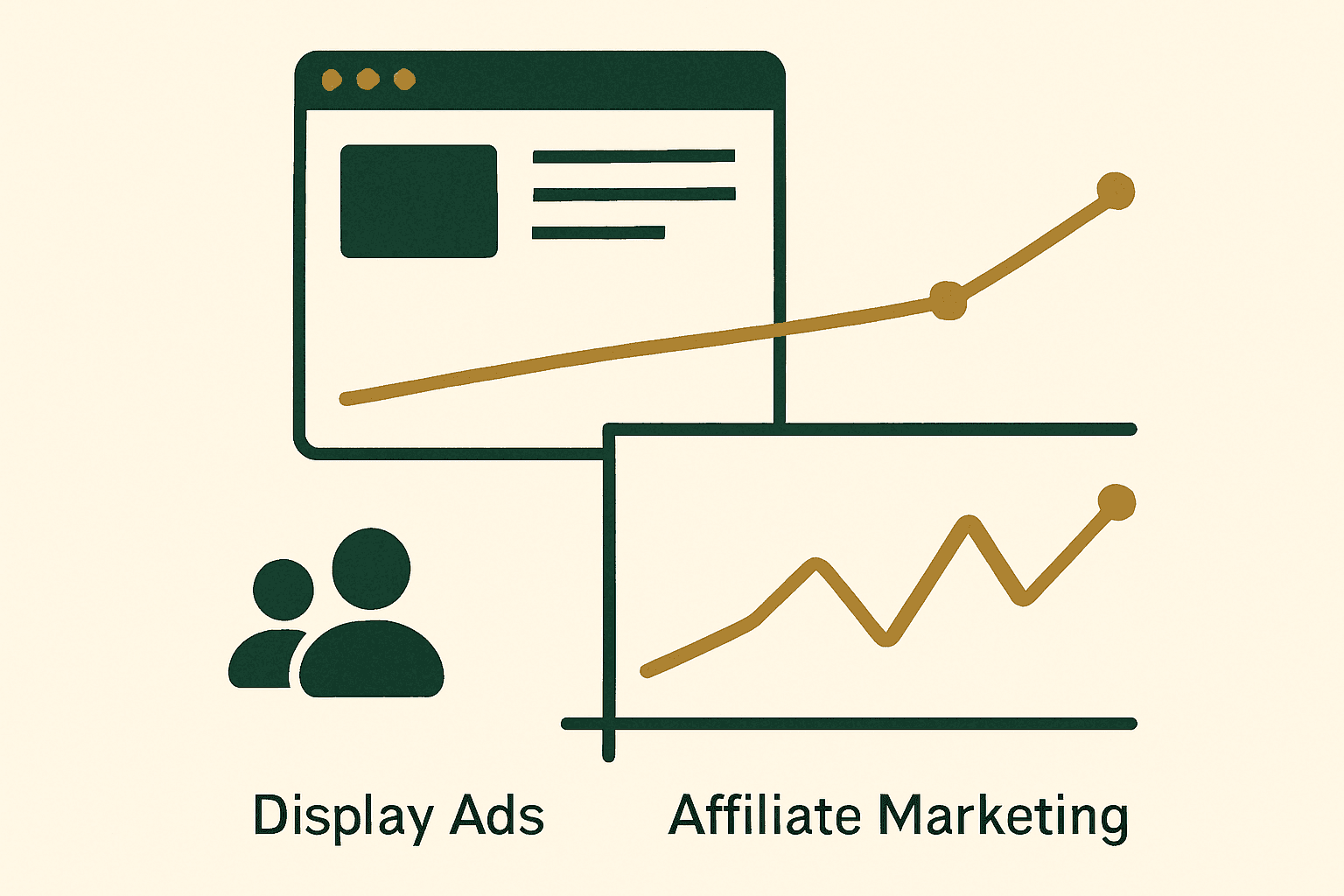
Display ads pay you for attention. You place ad units on your site, visitors load pages, and you earn based on impressions, viewability, click demand, and auction quality. Affiliate marketing pays you for action. You send a visitor to a merchant or software company, and you earn when that visitor buys, starts a trial, or completes some other tracked conversion.
That difference changes everything. Ads reward scale. Affiliate rewards intent. A page getting 100,000 pageviews on a broad topic might do fine with ads and almost nothing with affiliate. A page getting 3,000 visits from people searching for the best software, hosting, VPN, finance tool, or specialized gear could make much more with affiliate than with ads.
| Factor | Display ads | Affiliate marketing |
|---|---|---|
| What you get paid for | Impressions and ad demand | Clicks that convert into tracked actions |
| Best for | Informational content with broad traffic | Commercial and product-led content |
| Traffic requirement | Can start low, improves with scale | Can work with lower traffic if intent is strong |
| Income stability | Usually steadier month to month | Usually more volatile |
| Upside per visitor | Usually lower | Usually higher |
| Optimization lever | Layout, viewability, network, geography | Offer fit, rankings, CTR, conversion rate |
When display ads make more sense
Display ads are usually the right first monetization layer when your site has mostly informational content, low commercial intent, or a wide mix of topics. They also make sense when you want predictable monetization without depending on a small set of merchant programs.
- Your traffic is growing, but most pages are not naturally recommending products.
- Your audience is early in the research journey, not ready to buy yet.
- A large share of visitors comes from countries with weaker affiliate conversion rates.
- You publish high pageview-per-session content and want to monetize every visit.
- You do not want earnings tied heavily to a few merchants changing terms or cutting commissions.
As of 2026, approximately, the entry points across ad networks still differ a lot. Google AdSense remains the easiest place to start if you’re eligible and just need a basic setup. Ezoic is still commonly used by smaller publishers wanting more optimization tools. Monumetric is typically a step up once traffic is more established. Mediavine and Raptive remain the premium targets for many content publishers, with traffic and quality thresholds that can change over time, but are typically much higher than beginner networks. In practice, the right question isn’t just whether ads work. It’s whether your current traffic quality is strong enough to move beyond AdSense-level monetization.
Typical ad network progression
- Start with AdSense when you need the simplest path to monetize.
- Test Ezoic if you have enough traffic and want experimentation around layout and yield.
- Consider Monumetric when your traffic and content quality are more established.
- Aim for Mediavine or Raptive if you have sustained traffic, strong content standards, and mostly qualifying geographies.
As of 2026, approximately, the rough thresholds many publishers watch are around low traffic for AdSense, roughly 10,000 monthly visits for some Ezoic entry paths, roughly 10,000 to 50,000+ monthly pageviews for Monumetric programs depending on current terms, and around 50,000 sessions per month for Mediavine, with Raptive generally serving larger publishers and requiring stronger overall site quality. These numbers can shift, and acceptance is never just about traffic.
When affiliate marketing makes more sense
Affiliate is usually the better model when your content sits close to a buying decision. That includes product reviews, alternatives, best-of lists, tutorials that require a tool, and comparison pages. If your visitors are searching with words like best, review, pricing, compare, alternative, coupon, or how to choose, that traffic often monetizes better with affiliate than with display ads.
The reason is simple: advertisers pay more when a visitor actually becomes a customer. If your content helps users decide and the merchant’s page converts reasonably well, you can earn far more from a small number of high-intent clicks than you would from thousands of ad impressions.
This is also why affiliate can work before you have big traffic. A small site with the right content can often beat a bigger informational site on a per-visitor basis. But affiliate is less forgiving. You need the right offer, the right page structure, and enough trust to get the click. If you need the mechanics refresher, see how affiliate marketing works.
Signs a page is better suited to affiliate
- The page exists to help visitors choose between products, services, or software.
- Users regularly ask which option is best, cheapest, fastest, or easiest.
- The merchant has a real affiliate program with sensible commissions and tracking.
- Your content can honestly recommend or compare the offer.
- A visitor does not need many more sessions before making a purchase decision.
Roughly $2,430–$4,050/mo in commissions at this intent
Earnings: ads are steadier, affiliate has more upside
For most publishers, ads are easier to forecast because revenue scales more directly with pageviews and RPM. Affiliate revenue depends on several moving parts: rankings, click-through rate to merchant, merchant conversion rate, commission structure, attribution window, and whether the program stays stable.
| Metric | Display ads | Affiliate marketing |
|---|---|---|
| Main benchmark | RPM or page RPM | Earnings per click, conversion rate, EPC, revenue per visitor |
| Typical behavior | More linear with traffic | More spiky with rankings and offer performance |
| Downside risk | RPM swings with seasonality and geography | Program cuts, tracking issues, lower conversions |
| Best case | Strong premium RPM on large traffic | Very high earnings from a few top pages |
As of 2026, approximately, many general content sites see ad RPMs that are good enough to create a reliable floor, especially with strong US, UK, Canada, and Australia traffic. Affiliate can exceed that floor by a lot on money pages, but it can also underperform badly if the content is too top-of-funnel, the affiliate links are weakly placed, or the merchant page converts poorly. It varies by niche, geography, and season.
The hidden trade-offs most site owners miss
The big mistake is treating ads or affiliate as a pure earnings comparison without looking at side effects.
- Ads can reduce page speed, increase clutter, and sometimes lower affiliate click-through on commercial pages.
- Affiliate can create concentration risk if one program drives most of your income.
- Ads monetize nearly every page; affiliate usually monetizes only the pages close to a transaction.
- Affiliate content often takes more editorial effort because recommendations need to be credible and current.
- Ad income is easier to diversify across many pages; affiliate income is often concentrated in fewer pages and offers.
There is also a trust angle. Overloaded comparison pages with aggressive affiliate placements can hurt credibility. On the ad side, excessive density can annoy users and reduce engagement. The best monetization setup is the one that preserves the usefulness of the page while making the economics work.
The best strategy for most sites: use both, but not everywhere
For most established sites, the strongest answer to affiliate marketing vs display ads is a segmented strategy.
- Use display ads on broad informational pages where affiliate intent is weak.
- Use affiliate-first layouts on commercial pages, reviews, comparisons, and tutorials tied to a product.
- Keep ad density lighter on your highest-intent pages to protect affiliate clicks.
- Use internal links to move visitors from informational pages into commercial pages where affiliate monetization fits better.
- Review revenue by page type, not just sitewide totals.
How to choose if you’re starting from scratch
If you’re a newer publisher, choose based on the next 20 pieces of content you can realistically publish.
- Choose ads first if your content plan is mostly informational guides, definitions, news, entertainment, recipes, or broad education.
- Choose affiliate first if your content plan is mostly reviews, comparisons, product-led tutorials, and buying guides.
- Choose both if your niche naturally supports top-of-funnel and bottom-of-funnel content together.
- If you are unsure, start by mapping each planned page to informational, commercial investigation, or transactional intent.
That intent mapping will usually tell you the answer faster than any generic revenue estimate. A site can have millions of low-value pageviews and still struggle with affiliate. Another site can have modest traffic and do well because the visitors are close to a purchase.
A simple rule of thumb
If the page helps someone learn, ads are usually the default. If the page helps someone choose, affiliate is usually the default. If the page does both, test a balanced setup and measure which monetization path creates the highest revenue per session without hurting user experience.
If you’re deciding between ads or affiliate for your current site, don’t force a sitewide answer. Make the decision page by page, based on intent, traffic source, geography, and how close the visitor is to a transaction. For the ad side specifically, review display ad earnings to sanity-check what your traffic could typically support.
Is affiliate marketing better than display ads?
Can you use affiliate links and display ads on the same site?
Do display ads require more traffic than affiliate marketing?
What pays more in 2026, affiliate or ads?
Should beginners start with ads or affiliate?
Get the next guide by email
One practical email when we publish.