
How to Monetize a Website by Selling Your Own Products (2026
Learn how to monetize a website by selling your own products, from digital offers and pricing to platforms, funnels, and scaling in 2026.

If you want the highest-upside answer to how to monetize a website by selling your own products, this is usually it. Selling your own offer gives you far more control over margins, customer relationships, and long-term revenue than ads alone. For most sites, I’d treat product sales as the primary monetization engine and use ads as a secondary layer where they fit. If you still need the ad side mapped out, start with our display ad monetization guide.
The short version is simple: pick a problem your audience already has, package the solution into a product, put it on a platform that matches your complexity level, and drive traffic into an email capture plus checkout flow. For many publishers, that product starts with templates, guides, swipe files, calculators, or mini-courses. For others, it becomes a full membership, software add-on, or consulting-backed information product.
Compared with ad networks like AdSense, Ezoic, Monumetric, Mediavine, and Raptive, selling your own products usually requires more setup but can outperform display revenue by a wide margin. As of 2026, approximately, ad monetization thresholds and RPMs still vary a lot by niche, geography, and season. A site with decent traffic can often make more from a well-matched $29 to $199 product than from adding another ad unit.
Why selling your own products is often the best monetization model
Ads are easy to bolt on. Your own products are harder, but they create assets. When a visitor buys from you directly, you’re not just earning a one-time amount. You’re learning what problem they care enough to pay to solve. That improves your content strategy, email sequence, product roadmap, and upsells.
- Higher revenue potential per visitor than display ads, typically
- More control over pricing, packaging, and customer experience
- First-party customer data you can use for retention and upsells
- Less dependence on ad market swings and traffic RPM volatility
- A business model that can expand into courses, memberships, or software
The tradeoff is execution risk. A weak offer will underperform even with good traffic. A mismatched platform can create needless support work. And if your audience only wants quick answers, a big-ticket course may be premature. The monetization model is strong, but the product has to match buying intent.
What kinds of products work best on content websites
The best products are usually the closest paid extension of what already performs on your site. If a post gets traffic because it solves a problem, the product should help the reader solve that same problem faster, more completely, or with less trial and error.
For most site owners, the easiest place to start is to sell digital products. Digital products have low delivery costs, fast iteration cycles, and no inventory risk. You can update them after launch, bundle them, and test positioning without rebuilding your business.
- Templates and worksheets
- Ebooks and premium guides
- Spreadsheets and calculators
- Checklists, SOPs, and swipe files
- Premium newsletters or research packs
- Mini-courses and full online courses
- Membership communities and resource libraries
- Downloadable assets such as design packs, code snippets, or lesson plans
Physical products can work too, but they add shipping, returns, margin compression, and operations complexity. If your audience clearly wants a tangible item, sell it. If not, digital is usually the cleaner starting point.
How to choose the right product idea
Don’t brainstorm in a vacuum. Use audience evidence. The strongest product ideas usually come from pages with traffic, emails with repeated questions, search queries with buying intent, or manual workflows your readers keep asking you to simplify.
- Review your top-performing content by search traffic and conversions.
- Look for posts where visitors want a shortcut, done-for-you asset, or deeper implementation help.
- Pull common questions from comments, replies, support requests, and consult calls.
- Group those questions into outcomes people would pay for.
- Pick the narrowest product that solves one high-value problem.
A good first product is usually narrow, practical, and immediately useful. Broad products are harder to position. A template bundle for one workflow often sells more easily than a giant “everything you need” package because the buyer immediately understands the outcome.
Validate demand before you build too much
You do not need a giant launch to validate demand. In fact, the fastest validation usually comes from a simple landing page, a waitlist, and one traffic source you already control. If people won’t opt in for the offer framing, they probably won’t buy the full product either.
- Create a landing page with the problem, outcome, deliverables, and early pricing
- Offer a waitlist or pre-order if the audience trust is strong enough
- Mention the product naturally in relevant high-traffic posts
- Send the idea to your email list and track click interest
- Use call-to-action tests on posts that already rank for related queries
Validation doesn’t need perfect data. You’re looking for directional proof that the problem matters and that the packaging makes sense. If you get clicks but no buyers, the issue may be price, trust, or product clarity. If you get no clicks, revisit the offer itself.
Best product formats for different audience sizes
Audience size matters, but not as much as audience intent. A small audience with urgent problems can outperform a large general-interest audience. Still, some formats tend to fit certain stages better.
| Audience stage | Good first product | Why it fits |
|---|---|---|
| Early-stage site with modest traffic | Template, guide, checklist, or spreadsheet | Fast to create, low support burden, easy to validate |
| Growing site with engaged email list | Bundle, workshop, or mini-course | Adds perceived value without major production overhead |
| Established site with strong expertise | Full course or premium resource library | Supports deeper teaching and higher price points |
| Loyal audience with recurring needs | Membership or subscription | Works well when buyers need ongoing updates or access |
| Commerce-oriented audience | Physical or hybrid product | Useful when the buyer expects a tangible solution |
Platforms to sell on: Shopify, Teachable, and other digital product platforms
Platform choice depends on what you’re selling. If your site will sell multiple product types, physical goods, or a broader storefront, Shopify is often the cleanest operational choice. If your main offer is a structured course, Teachable is a straightforward option. There are also other strong digital product platforms depending on whether you need memberships, downloads, bundles, affiliates, or community features.
| Platform type | Best for | Watch-outs |
|---|---|---|
| Shopify-style storefront | Stores selling digital plus physical products, bundles, and broader ecommerce catalogs | Can be more than you need for one simple download |
| Course platform like Teachable | Structured lessons, student progress, and course delivery | May feel limiting if you later want a full storefront or complex content hub |
| Download-focused platform | Simple PDFs, templates, files, and lightweight bundles | Often fewer advanced teaching or community features |
| Membership platform | Recurring access, gated libraries, and community content | Requires stronger retention and ongoing content cadence |
As of 2026, approximately, most mainstream platforms support digital file delivery, discounts, basic email integrations, and order analytics. The real difference is workflow. Pick the platform that reduces operational drag for the product you’re selling right now, not the fantasy business you might have three years from now.
How to price your products without guessing
Pricing is where many site owners undercut themselves. If the product saves time, reduces mistakes, or accelerates a meaningful outcome, price should reflect value, not just file length. A 12-page checklist that saves someone three hours can be worth more than a 150-page ebook they never finish.
Use comparable products for context, but don’t copy blindly. Your audience, authority, and traffic source mix all matter. If you need a deeper framework, review how to price digital products based on buyer intent, transformation, and support load.
About 120 buyers → $35,640 at launch
- Low-ticket: typically impulse-friendly products such as templates, guides, and mini-assets
- Mid-ticket: typically bundles, workshops, and more complete solution packs
- Higher-ticket: typically courses, cohorts, memberships, or niche professional resources
As of 2026, approximately, many simple digital products are tested first in lower price ranges, while more comprehensive bundles and courses are often tested at higher ranges. Exact outcomes vary by niche, geography, and season. What matters most is alignment between problem urgency and offer clarity.
Build a sales page that converts from existing content traffic
A sales page does not need hype. It needs message match. Someone arriving from a search-driven article should instantly see that the product is the next logical step from the content they just consumed.
- Lead with the problem and the outcome
- Explain exactly what’s included
- Show who the product is for and not for
- Clarify the time-saving or mistake-avoiding benefit
- Add a clear call to action above the fold and again near the end
- Answer objections around fit, difficulty, format, and refund terms
For content websites, the strongest sales pages usually feel like a continuation of the article rather than a hard pivot into generic copywriting. Keep language concrete. If the product includes templates, say how many and what they do. If it’s a course, explain the modules and expected outcome.
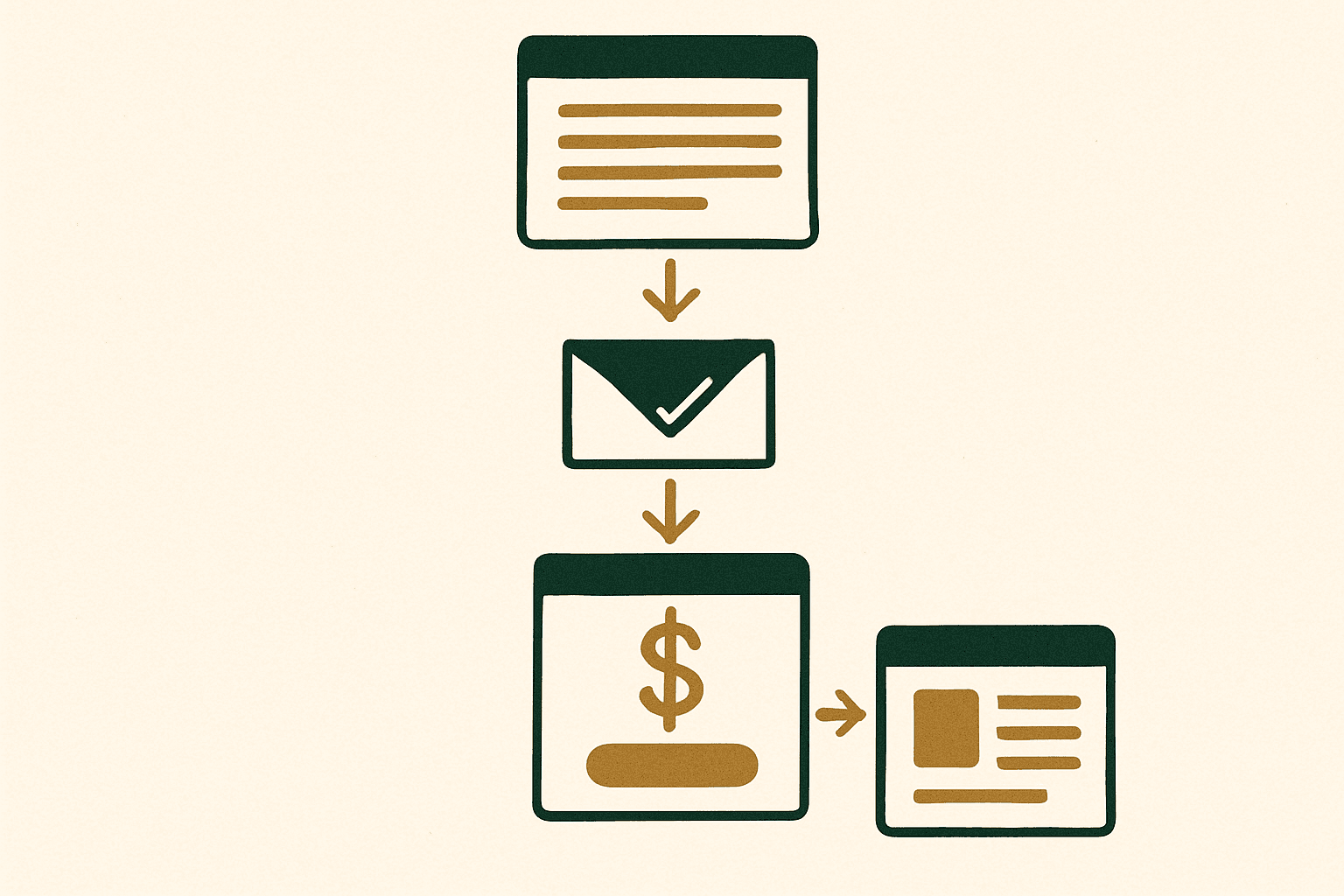
Use your website traffic to create a simple product funnel
Most publishers already have the raw material for a funnel: search traffic, internal links, and a few posts that attract the right visitors. You don’t need complicated automation on day one. You need one path from content to email capture to purchase.
- Publish problem-aware content that ranks or earns repeat visits
- Add a contextual content upgrade or lead magnet
- Send subscribers to a focused product page
- Follow up with a short email sequence that handles objections
- Offer a relevant upsell or bundle after purchase
This works especially well when the lead magnet is tightly related to the paid offer. A free checklist can lead into a template pack. A free lesson can lead into a course. A free calculator can lead into a full toolkit.
Email is usually the bridge between traffic and sales
If you rely only on one-visit conversions, you’ll leave money on the table. Most visitors need context and trust before buying, especially for educational or professional products. Email gives you that follow-up channel without depending on platform algorithms.
- Welcome email with the promised resource
- Problem-agitation email that frames the cost of inaction
- Teaching email with one useful win
- Product email showing the full solution
- Objection-handling email with fit details and common questions
You don’t need a massive sequence. Even three to five well-written emails can outperform a passive sales page, particularly if your content audience is search-first and not yet familiar with your paid offers.
When to create online courses instead of smaller products
A course makes sense when the buyer needs structured guidance, ordered lessons, and a clearer transformation path. If your audience can get the result from a template or toolkit alone, a course may be overbuilt. If they need implementation coaching through multiple steps, it may be exactly right.
If your site’s authority and audience fit support this model, here’s a fuller breakdown of how to create an online course that actually matches your traffic and expertise.
- Use a course when the process must be taught step by step
- Use a smaller product when the customer mainly needs tools or shortcuts
- Use a workshop when the buyer wants implementation help without a full curriculum
- Use a bundle when multiple assets together solve one immediate problem
Memberships can increase recurring revenue, but only with ongoing value
A membership can be a strong model if your audience needs updated resources, community access, recurring research, or a growing library. It’s weaker when the need is one-and-done. Recurring billing doesn’t create recurring value by itself.
Before going subscription-first, read through the tradeoffs of how to build a membership site. The retention burden is real, and many publishers are better off starting with one-time offers before adding recurring access.
How selling your own products compares with display ads
This isn’t an either-or decision. Many websites do both. But the economics are different. Display ads monetize pageviews. Products monetize problem-solution fit.
| Model | Strengths | Limitations |
|---|---|---|
| AdSense and similar entry-level ads | Easy setup, low maintenance, immediate monetization | Usually lower revenue per visitor; dependent on traffic volume |
| Ezoic or Monumetric-type managed ads | Can improve yield as traffic grows | Still tied to traffic quality and ad market conditions |
| Mediavine or Raptive-type premium ads | Strong monetization for large quality audiences | As of 2026, approximately, require meaningful traffic thresholds and policy fit |
| Your own products | Higher upside, direct customer relationship, pricing control | Requires product creation, funnel setup, support, and testing |
As of 2026, approximately, ad network thresholds and earnings expectations continue to shift. AdSense remains accessible to many smaller sites. Ezoic and Monumetric have historically targeted growing publishers. Mediavine and Raptive have typically served larger established sites with stricter requirements. RPMs and earnings vary by niche, geography, and season, so don’t compare your product revenue strategy to someone else’s display ad screenshots.
Common mistakes that hurt product sales
- Building too much before validating demand
- Creating a broad product instead of a specific solution
- Choosing a platform that adds unnecessary complexity
- Underpricing because the product looks “small”
- Sending traffic straight to checkout without warming it up
- Ignoring email capture on high-intent posts
- Writing vague sales copy with weak deliverable detail
- Launching once and never iterating from buyer feedback
Most underperformance comes down to offer clarity, not traffic volume. If the right visitors are landing on the right page and still not converting, tighten the promise, show the deliverables more clearly, and reduce the gap between the article problem and the product outcome.
A practical launch plan for your first product
- Pick one proven audience problem from your existing content
- Choose the smallest product format that solves it well
- Create a simple sales page with a clear outcome and deliverables
- Set up checkout on the platform that fits the format
- Add contextual calls to action on relevant articles
- Create a short email sequence for new subscribers
- Launch to your list and measure clicks, sales, and objections
- Improve the product and page based on real buyer behavior
That sequence is enough to get real market feedback. You can add upsells, affiliates, webinars, communities, and automation later. The first goal is not to build a complex info-product empire. The first goal is to prove that your audience will pay for a focused solution.
Final takeaway: start narrower than you think
If you’re serious about how to monetize a website by selling your own products, don’t start with the biggest idea. Start with the clearest one. A narrow product tied to an existing high-intent article is usually the fastest path to first sales. Once buyers respond, you can expand into bundles, courses, or memberships with much less guesswork.
And if you’re balancing product revenue with ads, keep both levers in view. Use products where your audience needs deeper help, and use ads where traffic is broad and informational. For the ad side of that mix, circle back to the display monetization pillar.
What is the easiest product to sell on a website first?
Do I need a lot of traffic to make money selling my own products?
Should I use Shopify or Teachable to sell products on my site?
How should I price a digital product on my website?
Is selling your own products better than display ads?
Get the next guide by email
One practical email when we publish.