
How to Price a Digital Product (2026 Frameworks)
Learn how to price a digital product with practical 2026 frameworks for courses, templates, bundles, and launch pricing.
How to price a digital product comes down to three things: the outcome it creates, what your audience is willing to pay, and what buyers see as the closest alternatives. Start there, then validate with real offers instead of guessing from your effort or hours spent. If you already sell or plan to sell your own offers, this should fit into a broader monetization mix alongside ads, affiliates, and selling your own products. The right price is usually a tested range, not one magical number.
How to price a digital product: the short answer
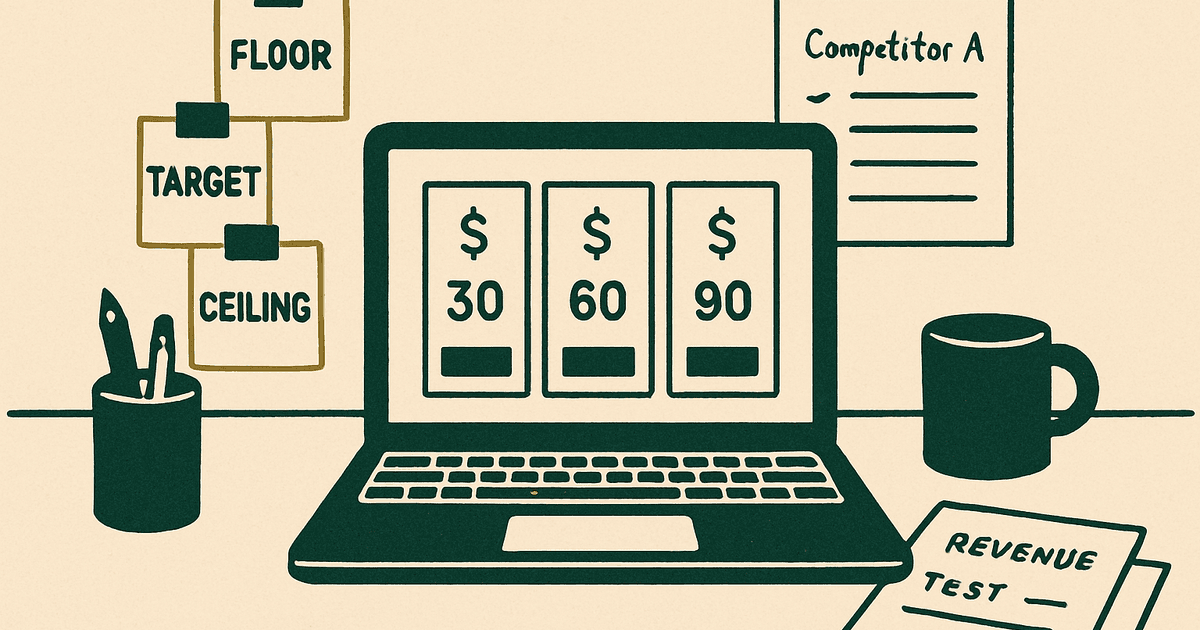
The practical framework is simple: define the buyer, define the result they want, map the alternatives they would consider, set a floor-target-ceiling range, then test the offer in market. That is the core of digital product pricing. A price that looks high on paper can convert well if the outcome is clear and the buyer is urgent. A price that looks low can still underperform if the positioning is vague.
Underpricing is usually a bigger mistake than starting slightly high. When you launch too low, you often attract weaker buyers, create more support load, leave no room for affiliates or paid acquisition later, and make future price increases harder. Starting a bit high is easier to fix because you can improve the offer, add proof, or test a lower entry point. Starting too low tends to lock in expectations.
What changes across low-ticket, mid-ticket, and premium offers is not just the number. Low-ticket products usually win on speed and impulse. Mid-ticket products need stronger specificity and clearer transformation. Premium offers need proof, trust, onboarding, and often some form of access, feedback, or implementation help. That is why course pricing, template pricing, and membership pricing should not all follow the same playbook.
Pick the right pricing model before you pick the number
A lot of pricing mistakes happen because the model is wrong before the amount is wrong. If the product solves a one-time problem, a one-time price usually makes sense. If the value compounds every month or the product is updated constantly, a subscription can fit better. If buyers have meaningfully different needs, tiered pricing often outperforms a single flat price.
| Pricing model | Best fit | Strength | Watch out for |
|---|---|---|---|
| One-time price | Ebooks, template packs, mini-courses | Simple to understand and easy to buy | Can cap lifetime value |
| Tiered pricing | Courses, template libraries, toolkits | Captures different willingness to pay | Too many tiers can hurt conversions |
| Subscription | Memberships, updated research, software-like tools | Recurring revenue and ongoing value | Churn and content pressure |
| Bundle pricing | Related products sold together | Raises average order value | Can reduce clarity if the bundle feels random |
| Pay-what-you-want | Audience-building offers, creator ecosystems | Low friction and useful for testing demand | Usually weak for premium positioning |
For templates and ebooks, a one-time price is typically the cleanest starting point. For courses, tiering often works better than one flat option because some buyers want only the self-paced material, while others will pay more for templates, office hours, feedback, or community. For memberships or software-like digital tools, subscription pricing can match buyer expectations if there is a clear ongoing reason to stay.
Bundles increase average order value when the products solve adjacent problems for the same buyer. The keyword there is adjacent. If the bundle is just a pile of unrelated files, buyers do not see added value. If it shortens the path to a result, bundling can support a higher effective price without feeling inflated.
Use outcome-based pricing, not just cost-based pricing
Cost-plus pricing is weak for digital products because marginal cost is near zero. You do not price a course, template, or ebook by adding up your hours and markup. Buyers are not paying for your production effort. They are paying for a result, a shortcut, reduced risk, or reduced confusion.
The most useful way to think about pricing is to estimate the transformation. Does the product save time? Help make money? Reduce mistakes? Remove technical complexity? Increase confidence in a high-stakes task? Those are value drivers. A template that saves a business owner five hours can sometimes justify a higher price than a long course that feels interesting but not urgent.
- Time saved: How many hours does this realistically remove?
- Money earned: Can the buyer plausibly recover the price through improved results?
- Risk reduced: Does it help avoid costly mistakes or compliance problems?
- Complexity removed: Does it turn a messy process into a repeatable system?
- Speed to result: Does it get the buyer to an outcome faster than free alternatives?
Niche, urgency, and buyer sophistication all change willingness to pay. A product for hobbyists usually prices differently from a product for agencies, operators, or business owners. A product solving a painful, immediate problem usually supports higher pricing than one solving a vague someday problem. Buyers who understand the cost of doing nothing also tolerate higher prices than buyers who still need basic education.
There still need to be guardrails. Outcome-based pricing does not mean making a huge promise and naming an aggressive price with no support. The price has to stay credible relative to the format, your proof, the depth of implementation help, and the alternatives available. If your product is self-serve and the result depends heavily on buyer execution, that usually caps how far premium pricing can go.
Research the market without copying competitor prices
Competitor research matters, but copying sticker prices is lazy research. Two products with the same headline can justify different pricing because the audience, proof, support level, templates, updates, and delivery model are different. You want to understand the market context, not mirror someone else’s number.
When you audit alternatives, look beyond price. Check format, depth, audience fit, proof, implementation help, bonuses, community, and how current the material is. Also compare direct competitors with substitutes. Free YouTube videos, blog posts, AI tools, communities, and downloadable checklists all cap your pricing power if your offer is not clearly more complete or faster to use.
| Factor | Questions to ask | Why it matters |
|---|---|---|
| Audience fit | Is it built for beginners, operators, teams, or experts? | A better audience match can justify parity or premium pricing |
| Depth | Is it surface-level or implementation-ready? | More depth can support a higher price if it saves time |
| Support | Does it include feedback, office hours, or community? | Access often raises willingness to pay |
| Proof | Are outcomes demonstrated clearly? | Proof supports premium pricing and lowers hesitation |
| Freshness | Is the material maintained and current? | Outdated offers lose pricing power quickly |
| Free substitutes | Could a buyer piece this together elsewhere? | Weak differentiation forces lower pricing or a stronger offer |
Use that comparison to decide whether your product deserves parity, a premium, or a lower starting point. If you are narrower, more current, and more implementation-focused than the alternatives, a premium can be reasonable. If your product is newer and lighter, a lower entry point may help. But that should be a strategy choice, not insecurity.
A practical digital product pricing framework
Here is the framework I would use for digital product pricing before launch.
- Define the buyer and exact use case.
- Write the outcome in one sentence.
- List the paid and free alternatives the buyer would compare.
- Choose the pricing model: one-time, tiered, subscription, or bundle.
- Set a pricing floor, target, and ceiling instead of one perfect price.
- Create an anchor with offer structure, not just a raw number.
- Launch to a warm segment first and watch conversion, refunds, and support load.
- Iterate from real buyer behavior, not your feelings.
The floor is the lowest price that still makes the product worth selling given support burden, refund risk, and brand positioning. The target is the number you believe best matches the value and market context. The ceiling is the highest plausible test price the market might accept if the positioning and proof are strong.
Anchoring matters because buyers do not evaluate price in a vacuum. A standard tier, a premium tier with access, or a bundle with strong bonus alignment can make your intended middle option feel more attractive. This is often more effective than shaving a few dollars off a single-price offer.
About 120 buyers → $35,640 at launch
Use the calculator here to model pricing bands, conversion assumptions, refund rates, and average order value. That is where many creators get surprised. A lower price is not automatically better if it requires much higher volume, produces more low-fit buyers, or reduces room for upsells and bundles.
How to price a course specifically
Course pricing deserves its own section because buyer commitment, transformation, and support level materially affect what buyers will pay. A self-paced course is a different product from a cohort, and both are different from a course paired with community and direct feedback.
As of 2026, approximately, self-paced introductory courses often sit in lower price bands than advanced implementation courses, while cohort-based or access-heavy offers can sit much higher. The right band varies by niche, geography, and season. In general, the more your course reduces uncertainty and adds accountability, the more pricing power you usually have.
| Course type | Typical pricing logic | What supports the price |
|---|---|---|
| Self-paced course | Priced around content depth and specificity | Clear modules, templates, examples, strong positioning |
| Self-paced + bonuses | Higher than content-only offers | Worksheets, swipe files, implementation assets |
| Cohort course | Higher due to schedule and accountability | Live sessions, deadlines, peer momentum |
| Course + community | Higher if the community adds ongoing value | Access, feedback loops, regular updates |
| Premium access course | Highest when direct support is included | Office hours, review, onboarding, hands-on help |
If you sell a self-paced course, tiering is usually worth testing. A base tier can include the lessons only. A higher tier can include templates or implementation assets. A premium tier can include office hours, a private group, or limited feedback. This approach helps you capture different willingness to pay without forcing every buyer into one decision.
Higher course pricing usually requires stronger proof, clearer positioning, and better onboarding. Buyers paying more need confidence that the course is for them, that they can complete it, and that the promised outcome is realistic. If your sales page explains topics but not transformation, price resistance goes up fast.
Launch pricing vs evergreen pricing
Launch pricing and evergreen pricing should usually be different. At launch, you have less proof and more uncertainty, so a founding-member or early-bird offer can make sense. Evergreen pricing should reflect the mature value of the offer once testimonials, onboarding, and support systems are stronger.
Founding-member pricing works when it is tied to a clear reason: you want feedback, case studies, or tolerance for rough edges. That is different from permanent discounting. If buyers suspect the product is always on sale, they learn to wait, which weakens pricing power over time.
- Use launch pricing when the offer is new and proof is limited.
- Use early-bird pricing when there is a real deadline and a real future price.
- Avoid constant discount cycles that train the list to delay buying.
- Raise price when proof, assets, support, and positioning materially improve.
Discounts help when they reduce launch friction for qualified buyers. They hurt when they become your default conversion tactic. A better long-term move is often to improve the offer structure, add aligned bonuses, or create a lower-friction entry tier rather than repeatedly cutting price.
Common pricing mistakes that kill revenue
The biggest mistakes are predictable: copying competitors blindly, pricing from effort instead of outcome, creating too many tiers, and changing prices before you have enough data. Another common one is ignoring the hidden economics of support, refunds, churn, and low-fit buyers.
- Copying a competitor price without matching their proof or support
- Charging based on how long it took to make the product
- Adding confusing tiers that increase decision fatigue
- Discounting too often and damaging buyer trust
- Changing pricing after tiny sample sizes
- Ignoring refund rates, churn, and support burden in true revenue
Signs your price may be too low include strong conversion but weak total revenue, unusually high support from low-commitment buyers, and resistance when you try to raise prices even slightly because the original positioning attracted the wrong segment. Signs your price may be too high include weak conversion from qualified traffic, repeated objections around value clarity, or buyer hesitation that improves when the offer is restructured rather than discounted.
What I’d actually do to price a new digital product in 2026
If I were pricing a new digital product today, I would start with a pricing band instead of trying to find a perfect number in private. I would define one buyer, one use case, and one core outcome. Then I would choose the simplest pricing model that matches the product. For a template or ebook, usually one-time. For a course, usually tiered. For an ongoing resource or tool, possibly subscription if there is a real reason to stay.
- Week 1: define buyer, transformation, alternatives, and pricing floor-target-ceiling.
- Week 2: build the sales page with one clear promise and one main CTA.
- Week 3: launch to a warm segment first, not a cold audience.
- Week 4: review conversion rate, refund requests, buyer objections, support load, and average order value.
After that first cycle, I would adjust one thing at a time. If qualified traffic clicks but does not buy, I would check positioning and offer structure before dropping price. If the product sells easily and support burden is low, I would test a higher number or a stronger premium tier. If the value is clear but hesitation remains, I would test anchors, bonuses, or better onboarding.
That is the practical answer to how to price a digital product: use value, alternatives, and buyer context to set a range, then learn from real sales. If you are pairing pricing with a go-to-market plan, work through your launch sequence next in this digital product launch guide.
How do I know if my digital product is priced too high?
Should I start with a lower launch price for a new digital product?
What is the best pricing model for an online course?
How often should I change digital product pricing?
Get the next guide by email
One practical email when we publish.